

Let's make this clear right out of the gate: The San Francisco 49ers aren't going to use each one of their picks in the 2026 NFL Draft on an outside pass-rusher.
However, in any given round with their six total picks, general manager John Lynch might opt to add a defensive end-type player to reinforce what was an injury-plagued and wholly tepid pass rush that finished dead last in sacks with a mere 20.
From that vantage point, it might be useful to know which defensive ends and outside pass-rushers could be targeted each time the Niners' number is called later this month.
We'll use Pro Football Focus' mock-draft simulator tool, and there's no sense for trades since we're pretty much just considering the potential options at each pick, currently, in every round.
Edge rusher-only mock NFL Draft for 49ers
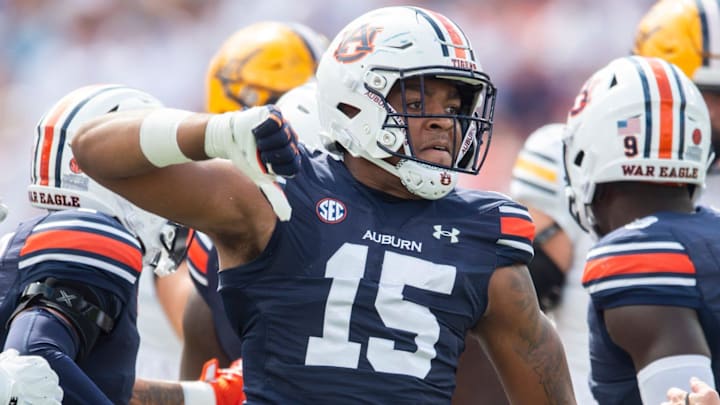
There was a choice here between Texas A&M's Cashius Howell and Auburn's Keldric Faulk, and the latter makes a bit more sense at No. 27 overall since he's much more polished as a run defender, and San Francisco needs edge setters against the run just as much as it needs pass-rushers.
A bigger body than Howell, too, Faulk's imposing 6-foot-6 and 276-pound frame is matched by a violent motor that'll make an immediate impact on base downs with the ability to translate into an every-down player once he develops his pass-rush plans.
That might take a year or two, but at least the 49ers get a starting-caliber defender who can make his presence known right out of the gate.
Should the Niners wait until Round 2 to grab an edge rusher, UCF's Malachi Lawrence might be the ideal find.
At 6-foot-4 and 253 pounds, Lawrence possesses the ideal blend of size and speed to overcome weaker blockers, and he already has a better array of pass-rush moves in contrast to Faulk.
Unlike Faulk, though, Lawrence is a liability against the run and should only be counted upon in obvious pass-rushing situations at this stage.
In light of Bryce Huff's offseason retirement, however, grabbing Lawrence as a third-down specialist wouldn't be a horrible replacement.
San Francisco doesn't pick again until its four Round 4 selections, meaning at this point in the draft, any pass-rusher is likely going to kick off his pro career as a purely rotational option. But that's fine. The 49ers need those kinds of bodies, too, to beef up their depth chart.
Florida's Tyreak Sapp, 6-foot-2 and 273 pounds, seemed to have a knack for coming up with big plays in key moments, and the Niners may appreciate his ability to "close out" games late.
Already a good run defender, though, San Francisco might look to deploy a player like Sapp strictly as a reservist, hoping to turn his so-so pass-rush plan into something useful while also banking on his ability to be a go-to backup.
Picking a few spots later in Round 4, the 49ers could theoretically get creative by adding Missouri defensive tackle Chris McClellan.
At 6-foot-4 and 323 pounds, McClellan looks much more the part of a 1- or 3-technique kind of interior lineman, but bumping him outside to the edge wouldn't be a wholly unorthodox move in coordinator Raheem Morris' five-man front, especially with a linebacker walking down to set the edge.
Plus, McClellan's bull rush is strong enough to overpower many a blocker, especially when said blocker is busy worrying about a blitzing linebacker.
McClellan's first step would eliminate him from being a true edge defender, but the versatility could make for a useful commodity.
Perhaps it wouldn't be a shock to see the 49ers use their back-to-back late-Round 4 picks on edge rushers, pitting them against each other in a training camp competition for one true spot on the 53-man roster.
Western Michigan's Nadame Tucker, 6-foot-2 and 247 pounds, has a far superior first step than McClellan and also possesses an uncanny ability to force fumbles, boasting four of those last year after transfering from Houston.
Not a quality run defender, Tucker's speed and burst certainly stand out in all the right ways.
But fans will recall those FBS-leading 21 tackles for a loss and 14.5 sacks, hoping that kind of output will somehow translate to the NFL level.
At 6-foot-6 and 258 pounds, Iowa's Max Llewellyn possesses many of the same traits as Tucker, including a good first step and burst, and the latter might actually be more polished with his array of pass-rushing moves.
Similarly, though, neither late-round prospect is projected to be adept against the run. And one might argue Llewellyn is actually worse out of the two.
That might be fine for Llewellyn, who didn't put up Tucker-like numbers in any sense but might be the more physically imposing in comparison. And his pass-rush abilities might better translate to the kind of competition he'd face at the NFL level.
Even if teams like the Niners would be unwise to think about deploying him on anything but obvious passing situation.
Again, we know... San Francisco won't solely draft edge rushers. But at least you know some round-by-round possibilities now.
 Add us as a preferred source on Google