

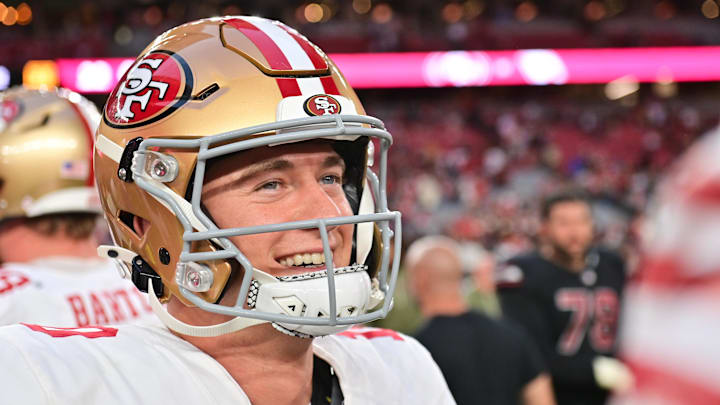
Understandably, there's been plenty of buzz surrounding the possibility of the San Francisco 49ers trading backup quarterback Mac Jones this offseason.
Jones resurrected his otherwise floundering career after being tasked with filling in for the injured Brock Purdy, helping the Niners go 5-3 during that particular stretch. Combine that with an upcoming quarterback market this offseason where supply is going to fall well short of demand (meaning more teams are going to need starting-caliber signal-callers than ones available), and it's not hard to see why Jones could become an attractive trade commodity this spring.
Heck, even general manager John Lynch didn't shut the notion down. And in Jones' case, he's certainly earned the right to be a starter somewhere after what he did earlier this season.
But there's a subtle reason why San Francisco might opt to hold onto Jones for a while, and it's not just for an extended piece of insurance to guard against another injury to Purdy.
No, it might have to do with maximizing Jones' trade value at the right time.
49ers may wait as late as 2026 trade deadline to move Mac Jones
So much of this is predicated on how the quarterbacking market pans out this spring, combining available names via both free agency and the 2026 NFL Draft. But, with the crop of free-agent and draftee signal-callers not exactly inspiring much confidence, perhaps Jones' market is never going to be higher.
Plus, teams would rather have their answer under center settled long before offseason programs begin, and Jones would certainly prefer to be in a system sooner than later.
That said, especially if other quarterbacks are made available this offseason, such as the Atlanta Falcons' Kirk Cousins or the Arizona Cardinals' Kyler Murray, the value on Jones would certainly be depleted, meaning the return on a would-be 49ers trade might diminish significantly.
Instead, Lynch and the Niners may opt to wait on a Jones trade, possibly as late as the NFL trade deadline.
It involves risk, sure. Other quarterback-needy teams would certainly scramble to fill the void, then sell whatever transaction to the fanbase as "the guy they wanted all along" to justify it.
But, should a starter completely flame out or suffer a serious injury, Jones' pricetag suddenly skyrockets.
Fans saw something similar along these lines way back in 2016 when the Minnesota Vikings lost then-starter Teddy Bridgewater to a serious injury on the eve of the regular season. With full-blown playoff aspirations at hand, the Vikings shipped off a first-round pick in a package to the Philadelphia Eagles for quarterback Sam Bradford, who'd been unseated as a starter by then-rookie Carson Wentz.
While things aligned perfectly for Philly in that scenario, and there's no guarantee something similar would happen for Jones and San Francisco, it's not hard to see why Lynch and Co. might hold off on a trade with the hope of moving QB2 much later in the year.
Not necessarily "if." More like "when."
 Add us as a preferred source on Google